
Notes From Posting Serial Fiction on Substack
I've learned some stuff - maybe it will help others

What qualifies you, Rebecca Rocket, to write such a post?
I will answer you (and the niggling self-doubt that I am unqualified) as follows:
I used to design and build websites for a living. I currently work in systems/technology/data analytics. I have a Bachelor’s Degree in writing. And I also spent my senior year as a copy and layout editor for our high school newspaper.
Perhaps most importantly, I have been posting the full 17 chapters of my novella to Substack for the last 4 months. (All that’s left is the epilogue).
So, I know some things about some things. And I’ve learned some other relevant stuff.
My Serial, as proof:
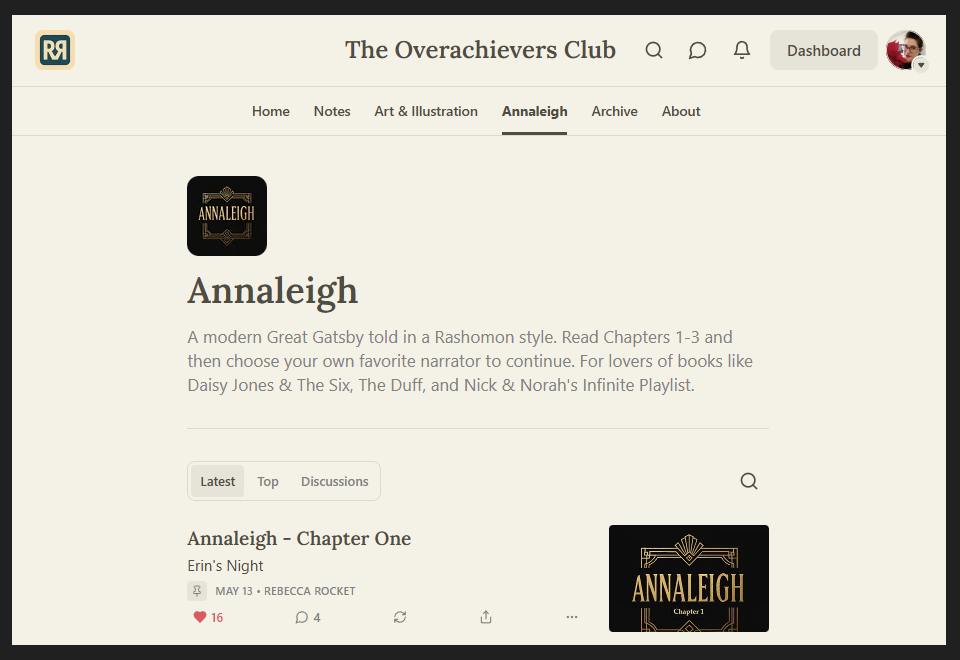
Annaleigh - Chapter One

This is a modern Great Gatbsy told in a Rashomon-style; everybody’s perspective varies. I encourage readers to pick their own favorite narrator and continue the story from there!
So, you posted something. Aren’t other people still more qualified?
Yes. Someone else is always more qualified. But that’s a terrible excuse to avoid sharing something that could be potentially helpful.
That said, if you’re starting completely from scratch, I want to point you to this very helpful section of Linda Caroll ‘s publication Hello Writer, which should be your first stop for setting up Substack — regardless of what you’re using Substack to do (or planning to use Substack to do).
Being very frank, my goal with Substack was just to share my novella. I’m not looking for a career change, a side hustle, or to be “discovered.”1 There is no doubt in my mind — and I don’t want there to be any in yours either — that this has colored some of my decisions.
That said, it has not colored my data gathering capabilities or my powers of observation! And I wield a 13-year career in data analytics to back those skills up! 🤓
Advice for people considering posting serial fiction
If you take only one thing away from reading my post, let it be this: COPYRIGHT YOUR WORK. I put that in bold, capital, italicized script, that’s how important it is.
In fact, this piece of advice is regarding posting anywhere on the internet. I just happened to post to Substack.
I’ve seen several people complaining about plagiarism of their articles. That sucks. But it would suck even worse if people stole your full-length fiction. You should definitely make sure you have the extra layer of “this is my work, here is my copyright certificate to prove it” protection. It’s $60 to register and takes less than an hour to complete the requirements. Just do it.
And make sure you list your pen name, if you’re using one!
Here’s the link, to make it easier for you!
Limitations
To be clear, this $60 insurance policy does not protect your work from being used to train AI — which I know is another complaint from folks.
The internet is a (sometimes too) public space. Once something is out there… it’s out there. You can keep fighting the fight against AI, but you should know….
Google is actively scraping unpaid postings from Substack
I found this out because I had a random visit from Google in my Traffic Sources. I was baffled, so I searched my novella on Google. And of course, there it was, scraped right up!
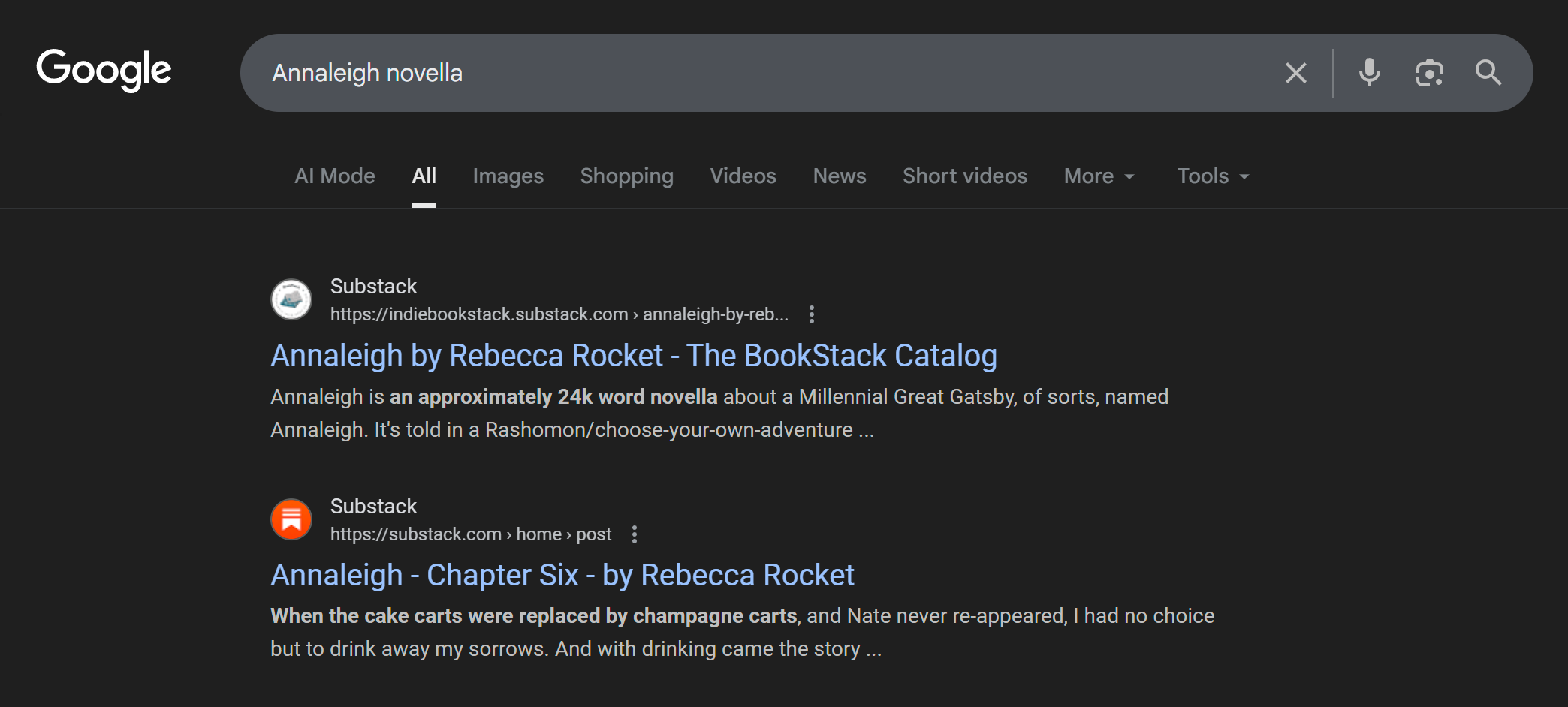
What is scraping? Don’t be surprised if you don’t know — I’ve had to explain it in my work life multiple times. Folks from the early days of Web 2.0 will likely remember the Wayback Machine. This is a primary example of a scraper.
Super-dumbed-down:
A scraper is another “entity” that visits your website (incl. your Substack page) and copies content from it, either in part or in full, and then re-uses it for any number of purposes.
I know this sounds like The Matrix, but there are in fact web “spiders” crawling around on the internet, gobbling up your content so that it can be used elsewhere.
In some cases, you want this. If you’re an employer/hiring manager, this is how job boards are picking up job postings from your company’s website. For free! If you’re researching the current cost of a product you’re considering purchasing, you probably also appreciate something like Camel Camel Camel or Google’s flight comparison; both of which scrape and index pricing data so they can tell you if you’re buying while prices are high or low compared to average.
However, if you have “paid” content — or content for which you should be getting paid (let’s say royalties on a song you released), you’re probably not so happy about scrapers. Paywalls can block your written content from scrapers, but they don’t block folks from re-posting or re-using your content through a manual copy/paste/upload scenario…
All of this to say, make sure it’s uncontested who originally generated what you wrote. REGISTER FOR COPYRIGHT!
Now, let’s get down to business.
Planning to Post Your Fiction Serial
The Primary Question: Separate Publication or Section in Your Main Publication?
This is probably the most important question if you are planning to post a serial on Substack.
I went with the section in my main publication option, but I know some folks choose the separate publication route. Both have benefits (I’m not going to enumerate them unless asked; you can make some inferences based on my comments, below), so it depends what most concerns you.
In my case: I started with 0 reader-base (beyond the real-life friends I lured in from Instagram). So, I saw absolutely no point in separating content for a group of people that were not already invested in me for “just that one thing we like reading from you.” In my case, it would have meant asking my friends to join two publications instead of one. So, I opted against it.
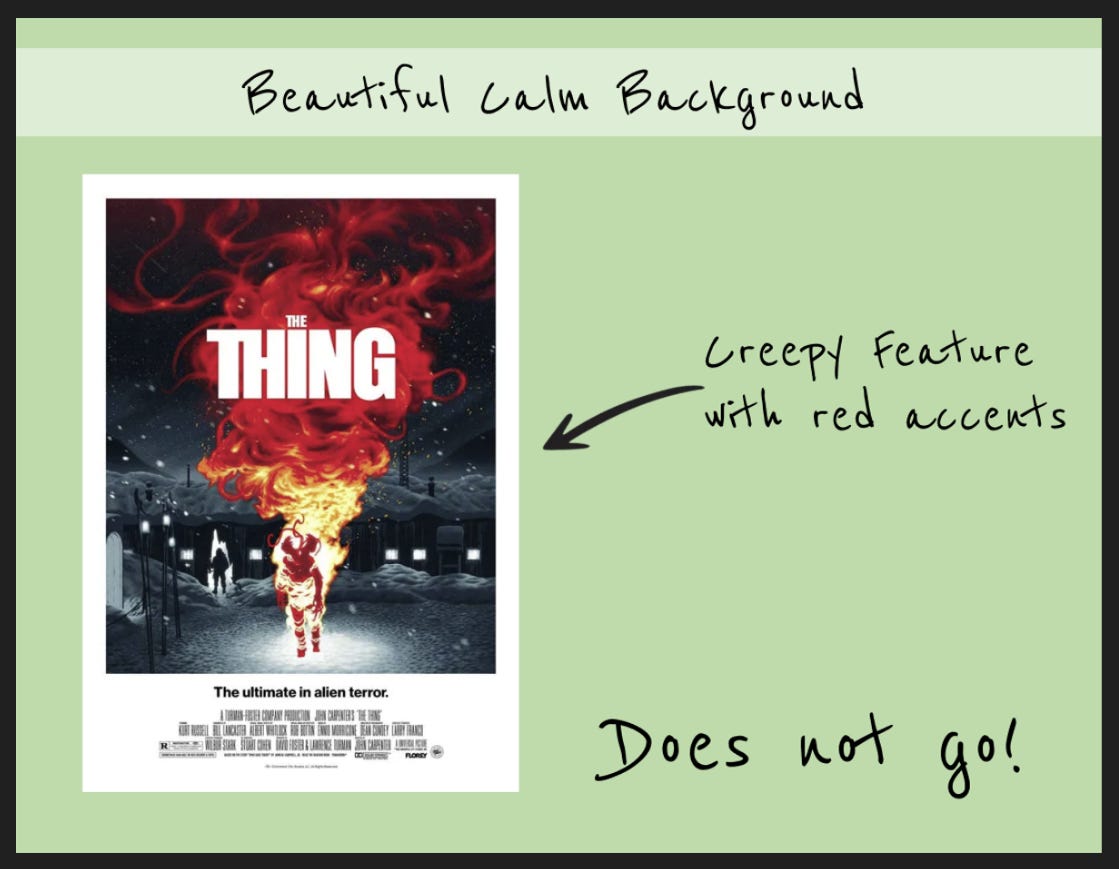
What I sacrificed, as a result, is that I didn’t get to stylize an entire “site” around my novella. For “brand cohesiveness” (or whatever you want to call it [I’m not a brand, so I’ll go with “artistic cohesiveness”]) that just means my primary site had to easily adapt to any kind of content. So, if you’re making this decision, don’t pick a calm, sage green background (because you normally talk about plants) for your main publication and then start sharing your novel about bloody alien space creatures that rival The Thing.
Like I said in my post about the Bellagio’s art and architecture, things don’t need to match, but they do need to “go.” That visual doesn’t go.
I’ve illustrated it to prove it to you.
This doesn’t just apply to colors, btw. It applies to fonts too. So, choose wisely.
Overall, I’ve been happy with my decision, but I could definitely see the benefits of making your serial its own, self-contained publication.
The Secondary Question: How do I cover chapter navigation?
If you weren’t even thinking about chapter navigation, well… start thinking about it!
I thought chapter navigation was a given, but I have heard from other writers that folks are missing directories, indexes, and even next/previous buttons. These are essential for ANY website navigation, but especially in a serial. Your engagement/views/readership will suffer if people cannot move from one chapter to the next. We live in a binge-culture, whether or not you like it, so, do your best to work with it!
I automatically put an index at the top of every post, but that was based on how I wanted the novella to be consumed when it was completed (ie. it should be read as a choose your own adventure; pick your primary narrator).
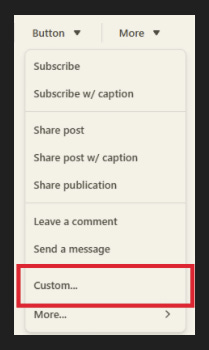
Some folks make a directory posting (smart, if you have a lot of chapters [like 70!] or a lot of content), and some just put next/previous buttons (use the toolbar to make text links or the custom buttons feature to make buttons!)
My Other General Learnings
Playing with the formatting tools
I’ll be honest, the LaTeX coding leaves some things to be desired. But I have a full HTML background and know everything that is possible! That said, I also remember the terrible outcome of MySpace’s over-allowance of customization. So, I guess I’m mostly happy to work within these confines….
I bent the “rules” or “intent” of the tools in several ways.
Pull Quote
This is the tool that centers text on the page. It says it’s for quotes, but it’s great for chapter headers or section breaks if you want a centered and italicized look.
Poetry
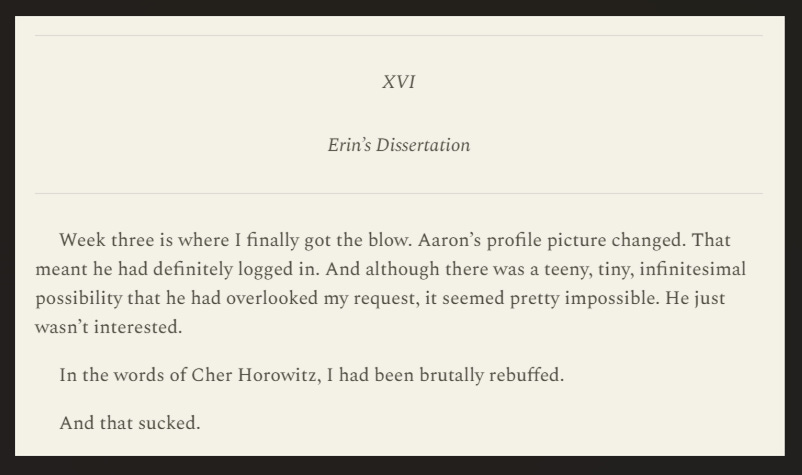
The Poetry coding allowed me to keep my stylized paragraph indentations. However, this had a drawback: it prevented Substack’s quote Restack feature from functioning. So, if you were trying to quote me, first of all THANK YOU!!! I’m honored. And second of all, I’m sorry that you weren’t able to do so. The few times I quoted myself in Notes, I had to remove the Poetry coding from whatever I wanted to quote, save the post, restack the quote, then go back and edit the post to reapply the Poetry coding. It was… a lot of effort.
But, because of my design background, and the vision I had for my story, it was important to me that I keep the classic paragraph indents. Look how pretty it is!
Read more about proper use of Pull Quote & Block Quote here, if you want.

And if you know a few more hacks for the LaTeX, do let me know! I love a good web-coding hack. I’m still learning all the ones available in Notion (which also uses LaTeX).
Vary your cover art from post-to-post
Your story logo should be recognizable, but not so recognizable that someone thinks they already read what you wrote. Keep in mind that Substack shows posts from MONTHS ago as if they were posted yesterday. It also shows you things that you already read. The best way around this conundrum is to make original art for each posting.
I’ll admit, I got lazy at this on many of the postings. And I know my readership suffered because of it; the views don’t lie!
It takes time and effort to make original art — even just a collage — for every post. (This is one of the reasons graphic designers are also up in arms about AI.) Part of me kept being like “you should make original art for the latest post!” and the other part of me was like “it took so long to come up with a logo to begin with, why can’t I just keep reusing it?!”
Anyway, don’t be like me! I am the worst example because I actually know how to use design tools. But I also used up all my time and energy making paragraph indents… My priorities are clearly skewed.
Some Arguable Learnings
Consider leaving the chapter number out of the post title
I went back and forth on including my chapter numbers.
On the one hand, I knew the higher the chapter number, the more alienated or overwhelmed a new reader might be to click on my post. It’s tough picking up a story at chapter 12. It’s the same as starting a TV show that already has 3 seasons and hasn’t concluded. So much homework!
On the other hand, it felt disingenuous to post chapter 12 as if it was a brand new story. Kind of like advertising that my store has free pizza, and then you walk in the store only to discover that you need to complete a 12-step obstacle course to get your free pizza. It seemed rude to me….
Think this one over and let me know where you fall….
Posting to Notes did not really help drive new readers
At least for me, posting to my Notes didn’t drive much readership. The majority of my new readers came from other kind folks (like Bradley Ramsey , Turtles of Alchemy , and Edward.Marlo.Ruiz ) specifically calling out/featuring my work in their publications.
A total tangent about what I’d rather have, than Notes
I’ve seen at least 3 Substackers recently asking themselves why — since they stopped posting on Facebook — they would begin posting on Notes and expect it to feel any differently. Good question. Answer: you shouldn’t.
And there are just as many keyboard activists floating around in there. (Eugh! Do not want.)
What I’d appreciate more is the type of indexing that folks like Hazel of BookStack and Anne-Marie Hubert have done, so that I can select what I want to read — including blog posts — by subcategory vs. primary category. I want Fiction BUT I’m actually looking for New Adult/YA, Romance, and/or Slice of Life stories to read. I will dabble in Fantasy, Sci-Fi, Horror, Fairytales, etc. but I’d appreciate being able to select easier, based on my mood. The current tags don’t cut it for me.
For more fact-based findings on the fallings of Notes
I “follow” multiple people, and I never see their Notes. Instead, I am inundated with people’s pillow-quote Notes that have 800 likes. I have to physically visit people’s pages to read what they’ve said recently (And I do! And then I spam them). However the Notes algorithm is written, it favors high “like” count on things it thinks I might like. But, newsflash, it’s usually wrong, and knows basically nothing about me. That said….
Other people posting my work in Notes did help drive new readers
If you needed an excuse to make some friends, here’s your excuse. I did gain some new readers if other folks restacked or shared my work in their Notes. It just didn’t work when I restacked myself. And, back to my comment on the Poetry setting, I also made this harder for folks, since Poetry can’t be restacked. Oops.
Do you have tips to share?
Additional Reading
A helpful post I did not have when I started:

I mostly wanted to prove to myself that I could do it. I have several published friends and I used to think to myself, “how on Earth were they so committed that they managed to write something that long?!” Well, I wrote it, so then it seemed silly not to share it!
And when I thought about the traditional route — and the rigmarole of finding a manager, an agent, etc. for something that was a passion project. It sounded like utter, draining, overkill. So, here I am!
Thanks so much for the shout out, Rebecca! I’m still under the weather, but wanted to say thank you. This is a wonderfully comprehensive piece.
This is super useful, thanks so much.
Quick note ref copyright in the UK: currently (2025) for UK-based writers and artists, copyright is automatically granted to the creator of the work under UK law, and nobody needs to pay anything in order to have copyright in their work.
I say this because there are probably a bunch of places online that will suggest you need to pay them to register your work if you are a writer based in the UK, but that’s not true.
However, it can be useful to email a digital copy to someone you trust, maybe even a lawyer or other such professional, and you can also do the old-fashioned thing of printing out your work and posting it to yourself.
Get the post office to put the date stamp over the seal of the envelope. When it arrives back with you, don’t open it! Just put it somewhere safe, still sealed, so the date stamp becomes the proof that it was in your possession at least from that date.
Write a note on the outside of the envelope that will remind you what’s inside it. Otherwise you might build up a collection of envelopes and then not know which one you need to open in case of requiring legal proof. Once opened, which should be done on front of a legal representative and/or in court, I think the whole thing becomes invalidated because you could just have put anything into an open envelope.